
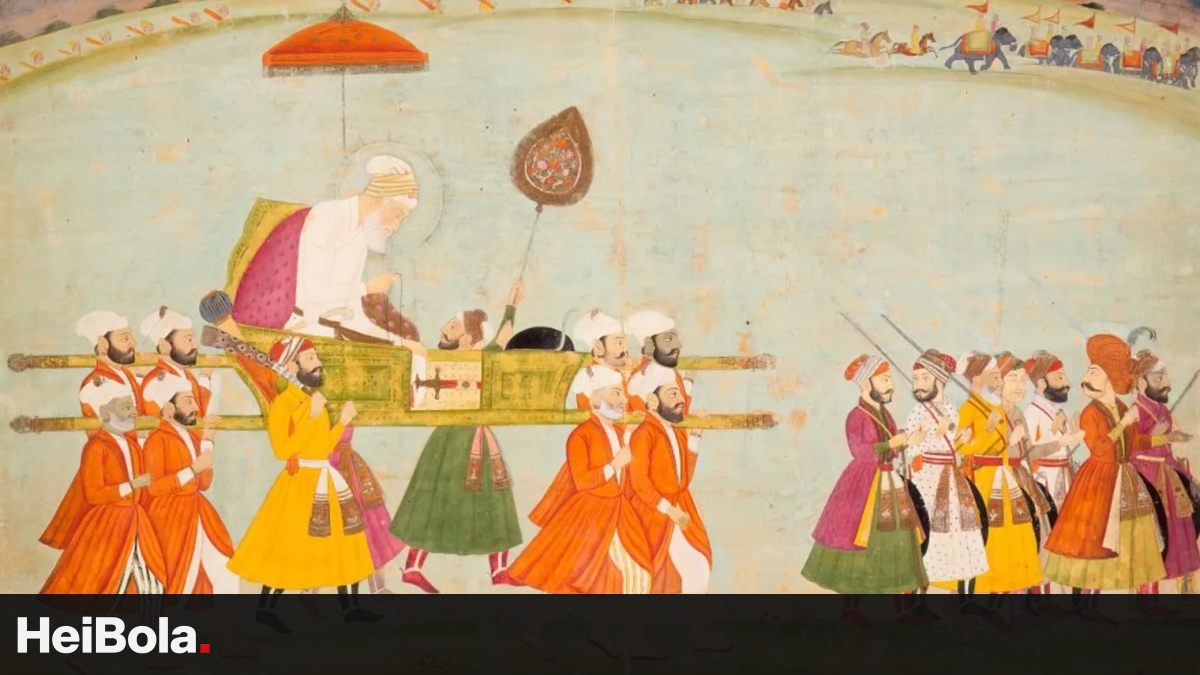
The Mughal Empire's information network, known as akhbarat, provided crucial insights into its operations during Aurangzeb's reign from 1658 to 1707. These brief news reports, compiled by armies of scribes, agents, and secretaries, circulated daily, connecting imperial and provincial courts across the vast empire.
Written in Persian on brittle paper, the akhbarat served as a blend of intelligence brief, official circular, and news bulletin, helping to knit together an empire that governed much of the Indian subcontinent and nearly a quarter of the world's population at its peak.

Munis D. Faruqui, a historian at the University of California, Berkeley, dedicated nearly two decades to studying over 6,500 pages of these reports housed in Kolkata's National Library.
His forthcoming work offers a fresh perspective on Aurangzeb and the late 17th-century Mughal Empire, revealing the complexities of its governance and the intricacies of its political landscape.

The akhbarat included details on court intrigue, military campaigns, appointments, finances, and gossip. Many of these reports were read aloud to assembled officials, facilitating communication and cohesion within the empire.
The volume of surviving material from the early 1680s onward is particularly noteworthy, providing an almost daily flow of reports that illuminate roughly a third of Aurangzeb's nearly half-century reign.
Faruqui's analysis challenges long-held beliefs about Aurangzeb's reign, revealing less evidence of widespread religious conversions often attributed to his rule. He highlights the political influence of figures such as Zinat-un-Nisa, Aurangzeb's daughter, who emerged as a powerful political actor and a significant support for her father during his later years.
This new understanding prompts a reevaluation of the Mughal Empire's historical narrative, particularly regarding the roles of women and eunuchs in the imperial court.
Faruqui's extensive research into the akhbarat not only sheds light on Aurangzeb's governance but also offers a glimpse into the sophisticated information network that characterized one of the early modern world's most significant empires.
His findings suggest that the Mughal state had a remarkably sophisticated grasp of its sprawling territories, affecting the lives of millions, sometimes for better and sometimes for worse. The akhbarat thus provides a unique opportunity to reassess not just Aurangzeb, but the Mughal Empire itself.